Two-Piece vs Three-Piece Wheels — 5 Differences Every Builder Must Know certified
Introduction
Two-Piece vs Three-Piece Wheels
Two-piece wheels and three-piece wheels are not simply different versions of the same thing at different price points.
They are fundamentally different constructions — each with its own engineering philosophy, its own visual character, its own performance implications, and its own place in the hierarchy of serious custom wheel building. Understanding the difference between them is not optional knowledge for anyone planning a high-level wheel build. It is the foundation on which every other decision — width, offset, finish, lip depth — is built.
At Elite BBS Wheels, we build both. We build two-piece BBS E88 sets for Porsche GT3 platforms, two-piece BBS RS builds for classic BMW and Volkswagen fitments, and three-piece conversion builds for platforms where maximum lip depth, precise offset control, and the visual drama of a deep dish profile are the primary objectives. We understand both constructions completely — their strengths, their limitations, and the specific circumstances in which each one is the correct choice.
This post explains the difference between two-piece and three-piece wheels clearly, completely, and without compromise — so that when you choose your next build, you choose with full knowledge of what each construction delivers and why it matters.
Why So Many Buyers Choose the Wrong Construction
Two-Piece vs Three-Piece Wheels Most buyers choose between two-piece and three-piece wheels for the wrong reasons.
Some choose two-piece because it is less expensive and assume they are getting a lesser product. Some choose three-piece because it looks more complex and assume complexity equals quality. Neither assumption is correct — and both lead to builds that do not fully deliver what the buyer actually needed.
The reality is more nuanced and more interesting than a simple quality hierarchy.
Two-piece wheels are not inferior to three-piece wheels. In many applications — particularly on modern performance platforms where weight, structural integrity, and certified safety standards are primary concerns — a two-piece wheel is the superior choice. The BBS LM, one of the most respected and widely used performance wheels in the world across factory motorsport programs and road applications, is a two-piece wheel. Nobody who understands BBS engineering would describe the BBS LM as a lesser product because it uses two-piece construction.
Three-piece wheels are not superior to two-piece wheels by virtue of their construction alone. They are superior in specific applications — where lip depth beyond what two-piece construction can achieve is required, where precise offset adjustment is needed without a full custom build, or where the visual character of a three-piece deep dish profile is a primary objective of the build.
The problem is that most buyers never receive a clear, honest explanation of what each construction actually offers — and so they choose based on assumption, price, or the influence of whoever sold them the wheels. This post exists to change that.
Two-Piece and Three-Piece Wheels Explained Completely
What Is a Two-Piece Wheel?
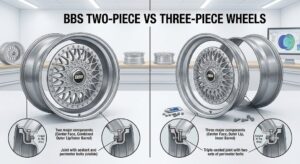
Two-Piece vs Three-Piece Wheels A two-piece wheel is constructed from exactly two components — a face and a barrel — joined together at a single interface using a ring of bolts around the inner circumference of the wheel.
The face is the front-facing structural component that carries the spoke design, the hub bore, and the bolt holes. The barrel is a single-piece unit that forms the inner and outer lip profile in one continuous form. Face and barrel are mated at the join line — the visible ring of bolts that encircles the wheel between face and lip — and sealed with an o-ring or gasket to prevent air loss.
Two-piece construction is the standard construction method for serious performance wheels across the BBS range and across the broader performance wheel market. It allows for a wide range of face and barrel combinations — enabling different widths, offsets, and lip depths within a given wheel diameter without requiring entirely new tooling for each combination.
The key advantage of two-piece construction is structural simplicity. With only one join interface — face to barrel — the clamping load is concentrated and consistent. Properly assembled with the correct hardware and seals, a two-piece wheel is a highly rigid, structurally efficient unit that is well-suited to high-speed, high-load applications.
What Is a Three-Piece Wheel?
A three-piece wheel is constructed from three separate components — a face, an inner barrel, and an outer lip — joined at two separate interfaces.
The face bolts to the outer lip at the front interface. The outer lip bolts to the inner barrel at the rear interface. The result is a wheel where the depth of the outer lip — the visible polished section between the face and the tyre — can be varied independently of the inner barrel depth, because both are separate components joined by separate hardware rings.
This independent lip depth control is the defining advantage of three-piece construction. It allows the outer lip to be made substantially deeper than two-piece construction can achieve within the same overall wheel width, creating the deep dish profile that defines the most visually dramatic custom builds in the classic and collector wheel market.
Three-piece construction also allows more precise offset adjustment after the wheel is initially built. By substituting a shallower or deeper outer lip, the effective offset of the wheel changes without requiring a complete rebuild. This flexibility makes three-piece construction particularly valuable for builds where the exact correct offset is being dialed in across multiple fitment attempts.
Structural Differences — How Each Construction Performs Under Load
Two-Piece vs Three-Piece Wheels The structural difference between two-piece and three-piece wheels is significant and often overlooked in discussions focused primarily on aesthetics.
Two-Piece vs Three-Piece Wheels A two-piece wheel has one join interface. Under load — cornering forces, radial fatigue, and kerb impacts — the structural integrity of the wheel depends on the quality of that single interface. A properly assembled two-piece wheel with genuine hardware and seals is an extremely rigid, well-integrated unit. The face and barrel behave almost as a single component because they are clamped at a continuous ring around the entire wheel circumference.
A three-piece wheel has two join interfaces. Under the same loads, both interfaces must maintain their integrity simultaneously. The outer lip and inner barrel join at the rear, and the face and outer lip join at the front. Each interface is a potential point of structural movement — and the overall rigidity of a three-piece wheel is inherently lower than that of a two-piece wheel of equivalent construction quality, because it has twice the number of join interfaces.
This does not make three-piece wheels unsafe. Properly built three-piece wheels with quality hardware and correct assembly are entirely suitable for road use and, in many cases, track use. But it does mean that for applications where maximum structural rigidity and certified safety performance are the primary requirements — factory motorsport programs, high-speed track use, and platforms where TÜV certification is required — two-piece construction is almost always the preferred choice.
Visual Differences — How Each Construction Looks on the Car
Two-Piece vs Three-Piece Wheels The visual difference between two-piece and three-piece wheels is perhaps the most immediately compelling distinction for enthusiasts and builders.
A two-piece wheel presents a single, continuous profile from face to outer lip. The join line — the visible bolt ring — is at a fixed position determined by the barrel geometry. The depth of the outer lip is determined by the barrel design and cannot be changed without replacing the barrel entirely.
A three-piece wheel presents a more layered, complex profile. The outer lip is a separate, visible component — and its depth can be made substantially greater than two-piece construction allows within the same overall wheel width. The result is the deep dish profile that defines the visual character of classic and collector wheel builds — a wide, polished outer lip that frames the face with a depth and drama that two-piece construction simply cannot replicate at the same level.
For builds where the visual objective is a deep, mirror-polished outer lip — a BBS RS2 double step conversion, a classic OZ Racing Futura rebuild, or a three-piece BBS RS build for a BMW F90 M5 — three-piece construction is the only way to achieve the desired result. The depth of lip that defines these builds is a physical consequence of the three-piece construction method, not a finish choice that can be applied to a two-piece wheel.
Weight Differences — What Each Construction Adds or Removes
Two-piece wheels are generally lighter than three-piece wheels of equivalent size and material.
The reason is structural efficiency. A two-piece wheel achieves its target width and offset with two components and one set of joining hardware. A three-piece wheel achieves the same dimensions with three components and two sets of joining hardware. The additional component — the separate outer lip — and the additional hardware ring add weight that a two-piece wheel does not carry.
On a modern performance platform where unsprung weight directly affects handling response, braking performance, and ride quality, this weight difference matters. A BBS LM two-piece wheel for a Porsche 992 GT3 is lighter than a three-piece equivalent of the same dimensions — and on a car driven at track speeds, lighter unsprung weight is a measurable dynamic advantage.
On a classic or collector platform where the visual objectives of the build are the primary concern — a BBS RS double step three-piece conversion for a BMW E36 or a full polish three-piece BBS RS2 build for an Audi S8 — the weight difference is acceptable in exchange for the visual character that three-piece construction delivers.
Repairability and Rebuild Potential
Both two-piece and three-piece wheels offer significant repairability advantages over one-piece cast wheels — and this is one of the most practically important reasons to choose multi-piece construction for any serious build.
On a two-piece wheel, a damaged face can be replaced without replacing the barrel. A damaged barrel can be replaced without replacing the face. Hardware and seals can be renewed without replacing any structural component. A two-piece BBS wheel that has been kerbed, corroded, or damaged can frequently be returned to new condition by replacing only the damaged component — which is both more economical and more environmentally responsible than replacing the entire wheel.
On a three-piece wheel, the same component-level repairability applies to all three pieces — face, outer lip, and inner barrel can each be replaced individually. Additionally, the outer lip can be replaced with a lip of different depth — effectively changing the visual profile and offset of the wheel without a complete rebuild. This makes three-piece construction particularly valuable for long-term builds where the wheel specification may evolve over time.
At Elite BBS Wheels, we rebuild both two-piece and three-piece wheels — replacing damaged components, renewing hardware and seals, refinishing faces and lips, and in many cases transforming worn or damaged sets into builds that exceed their original specification.
Two-Piece and Three-Piece Builds from Elite BBS Wheels
Real Builds That Demonstrate the Difference
Two-Piece — BBS E88 for Porsche 991 GT3-RS
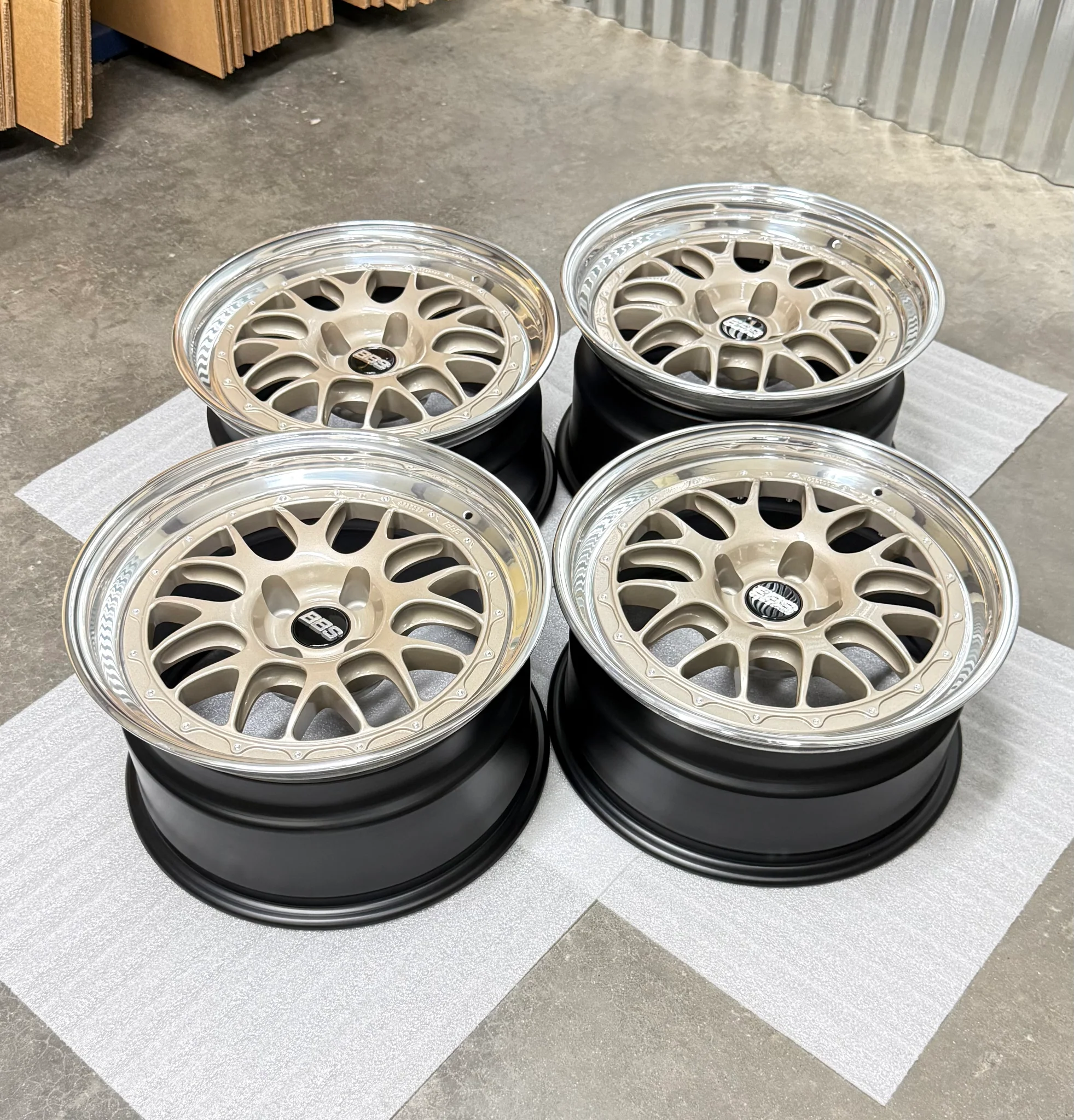
The BBS E88 for the 991 GT3-RS is a two-piece build — genuine BBS rim halves joined with genuine BBS hardware and seals, built to clear PCCBs, and finished in BBS Motorsport Gold with polished lips. Two-piece construction is the correct choice for this platform because structural integrity, correct certification, and PCCB clearance precision are all critical requirements. The rigidity of two-piece construction and the precision of the BBS hardware system deliver all three.
Two-Piece — BBS LM for VW MK7 MK8 GTI
The BBS LM is a two-piece die-forged wheel — brand new in original BBS boxes, TÜV and VIA certified, TPMS compatible. The BBS LM is produced as a two-piece wheel because two-piece construction delivers the structural performance, weight optimization, and safety certification that the LM’s reputation demands. On a GTI driven hard on road and track, the two-piece BBS LM is the correct tool for the application.
Three-Piece — BBS RS2 Double Step for Audi S8
The BBS RS2 double step three-piece conversion for the Audi S8 runs a 20×10″ square setup at ET25 with full polish throughout — face, barrel, and lip. Three-piece construction is the correct choice for this build because the deep lip profile that defines its visual character is only achievable through three-piece construction. The separate outer lip allows a depth that two-piece construction cannot deliver within the same overall wheel width — and on the wide, imposing proportions of the Audi S8, that depth is precisely what the build demands.
Three-Piece — BBS Style 42 Double Step for BMW F90 M5
The BBS Style 42 double step three-piece conversion for the F90 M5 runs a staggered 20×10″ ET25 front and 20×11″ ET30 rear in Motorsport Silver with polished lips. Three-piece construction delivers the lip depth required to give the F90 M5’s wide body the visual presence it demands — and allows the precise offset difference between front and rear to be achieved through lip depth variation rather than requiring two entirely different barrel specifications.
Three-Piece — BBS RS Double Step for BMW E36
The BBS RS double step three-piece build for the BMW E36 runs a square 17×9.5″ in Motorsport Gold with deep polished lips and gold hardware. Three-piece construction is the only way to achieve the deep dish profile that defines the visual character of this build — a profile that references the golden era of European tuning culture and looks exactly right on the E36 platform. No two-piece wheel achieves this lip depth at this diameter.
Generally Two-piece and three-piece wheels are not competitors in a quality hierarchy. They are different tools for different objectives — and choosing correctly between them requires understanding what each construction actually delivers and what your specific build actually demands.
Choose two-piece when structural integrity, certified safety performance, weight optimization, and precision fitment on a modern performance platform are your primary requirements. Choose three-piece when maximum lip depth, deep dish visual character, precise offset adjustment flexibility, and the layered aesthetic of a classic or collector build are what your platform and your vision demand.
At Elite BBS Wheels, we build both — and we build both correctly. Every two-piece build uses genuine BBS components with proper hardware and seals. Every three-piece build uses quality components assembled with the precision and care that a build of this complexity requires. The construction method changes. The standard does not.
Not Sure Whether Two-Piece or Three-Piece Is Right for Your Build?
At Elite BBS Wheels, we have built two-piece and three-piece wheel sets for Porsche, BMW, Volkswagen, Audi, Ferrari, and more — and on every build, the construction method is chosen for the right reasons, not the obvious ones.
If you are planning a custom wheel build and want to make sure you are choosing the right construction for your platform and your vision, we are ready to help.
Visit elitebbswheels.com or contact us privately today — tell us your car, your objectives, and your vision, and we will recommend the right construction and build it exactly righ
Posts Widget
-
1
 Genuine BBS Forged Wheels Delivered to Enthusiasts Around the World
Copyright 2014 © elitebbswheels.com