ET Offset Explained — 5 Reasons It Makes or Breaks Your Wheel Fitment
Introduction
ET offset is one of the most searched terms in the wheel and fitment world — and one of the least clearly explained.
Every wheel listing shows it. Every fitment guide references it. Every serious builder considers it before committing to a set of wheels. Yet the majority of buyers — even experienced enthusiasts — have only a partial understanding of what ET offset actually means, how it interacts with wheel width and vehicle geometry, and why choosing the wrong value can compromise everything from tyre clearance to handling dynamics.
ET offset is a single number measured in millimetres. But that number has consequences that extend across every aspect of how a wheel build performs — visually, mechanically, and structurally. It determines whether your wheels sit flush with the arch lip or disappear inside it. It determines whether your tyres rub under compression or clear with room to spare. It determines whether your wheel bearings wear at the rate the manufacturer intended or at a significantly accelerated rate caused by incorrect load geometry.
At Elite BBS Wheels, ET offset is one of the first things we discuss on every custom build — whether we are building BBS E88 wheels for a Porsche 991 GT3-RS, a set of BBS RS wheels for a BMW E30, or a custom OZ Racing Futura fitment for a BMW E39 M5. ET offset is never an afterthought. It is a foundational specification that shapes every decision that follows.
This post explains exactly what ET offset means, why it matters, how it interacts with wheel width and vehicle geometry, and how Elite BBS Wheels uses it to deliver correct, precise fitments on every platform we build for.
Why ET Offset Confuses So Many Buyers
The problem with ET offset is not that it is complicated. The mathematics behind it are straightforward. The problem is that it is almost universally under-explained at the point where buyers need to understand it most — when they are choosing wheels.
Most wheel listings present ET offset as a single number with no context. ET25, ET35, ET48 — the number appears in the specification alongside diameter and width, and is treated as if its meaning is self-evident. For buyers who already understand offset, it is. For buyers who do not, it is a number they either ignore or misinterpret — and the consequences follow.
The consequences of too little ET offset
A low ET number — or a negative ET — pushes the wheel outward toward the outer arch lip. On a car with insufficient arch clearance, this produces tyre rubbing on the outer arch liner or bodywork under compression and at steering lock. On a performance car, a significantly low ET increases the scrub radius — the geometric relationship between the wheel centreline and the steering axis at the tyre contact patch — placing additional stress on wheel bearings and suspension components that were not designed for that load geometry.
In practical terms, a wheel that is too far outboard looks aggressive in photographs and feels immediately wrong on the road. Steering becomes heavier. Wheel bearings wear faster. And on cars with tight arch clearances, the tyre makes contact with bodywork at exactly the moments you least want it to — under hard cornering, over bumps, and at full steering lock.
The consequences of too much ET offset
A high ET number pulls the wheel inward. This can cause the inner barrel, tyre sidewall, or spokes to contact suspension arms, brake calipers, spring perches, or inner arch liners. It also produces a visually recessed fitment — the wheel disappears inside the arch rather than filling it — which wastes the visual potential of any wheel and makes even the most beautiful BBS face look like an afterthought.
On cars where the inner clearances are tight — and on Porsche platforms with large brake calipers or ceramic composite brakes, inner clearances are frequently very tight — a wheel with too much ET offset can contact brake components on the first corner taken at speed. This is not a wear issue. It is an immediate structural and safety issue.
Neither outcome is acceptable on a serious build. Both are entirely avoidable with a correct understanding of ET offset before the order is placed.
ET Offset Explained Completely
What Does ET Offset Actually Mean?
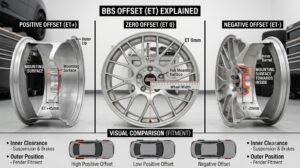
ET stands for Einpresstiefe — a German word that translates directly as insertion depth. It refers to the distance in millimetres between the wheel’s hub mounting face — the flat machined surface that contacts the vehicle’s hub — and the geometric centreline of the wheel.
A positive ET number means the hub mounting face is positioned outboard of the wheel centreline. This pulls the wheel inward — tucking it under the car toward the hub. The higher the positive ET number, the further inward the wheel sits.
A negative ET number means the hub mounting face is positioned inboard of the wheel centreline. This pushes the wheel outward — moving it away from the hub toward the outer arch lip. The more negative the ET number, the further outboard the wheel sits.
An ET of zero means the hub mounting face sits exactly on the wheel centreline — neither tucked in nor pushed out relative to the centreline geometry.
In practical fitment terms — a higher ET tucks the wheel further under the car. A lower ET pushes the wheel further out toward the arch. Every millimetre of ET offset change moves the wheel one millimetre inboard or outboard at the hub mounting face.
How ET Offset Affects Visual Stance
ET offset is the primary control for wheel position within the arch — and wheel position within the arch is one of the most visually significant aspects of any build.
A wheel that sits flush with the outer arch lip — where the tyre sidewall and the arch line are aligned — requires a specific ET offset that is determined by the wheel width, the hub face position, and the arch geometry of the specific vehicle. Achieving this flush fitment is one of the primary visual objectives of any serious custom wheel build, and it cannot be achieved by guessing.
A wheel that sits too far inward — caused by too high an ET — wastes the visual potential of any rim design. Deep polished lips disappear into the arch. Wide faces lose their visual impact. And the car looks as if the wheels were chosen for a different, narrower vehicle.
A wheel that sits too far outward — caused by too low an ET — can look aggressive in certain builds and on certain platforms, but requires confirmation that tyre, suspension, and arch clearances are adequate at all ride heights and steering positions before the specification is confirmed.
How ET Offset and Wheel Width Work Together
ET offset and wheel width are inseparable in fitment calculation — and this relationship is where the most common misunderstandings occur.
When a wheel is made wider, the additional width is distributed across both the inner and outer sides of the centreline unless the ET offset is adjusted to compensate. A wider wheel at the same ET offset will simultaneously move further inboard on the inner side and further outboard on the outer side.
This is why a staggered fitment — where the front and rear wheels are different widths — almost always requires different ET offsets front and rear. A wider rear wheel at the same ET as the narrower front wheel will sit further outboard at the outer face and further inboard at the inner barrel simultaneously. To maintain the same outer face position as the front wheel while running a wider rear, the rear ET offset must be increased proportionally.
Alternatively — and this is a deliberate design choice on many performance builds — the rear wheel is intentionally run at a lower ET than the front to push the wider rear face even further outboard, maximizing rear arch fill and creating the rear-biased, planted stance that defines many of the most visually compelling wheel builds.
Understanding this relationship is essential for any custom BBS build where precise arch fill, consistent visual stance, and clearance on both the inner and outer sides are all objectives simultaneously.
ET Offset and Brake Clearance
On performance cars — and particularly on Porsche and BMW platforms with large factory brake systems — inner clearance between the wheel spokes and the brake caliper is one of the most critical fitment considerations.
A wheel that does not provide adequate caliper clearance will contact the brake caliper on the first corner under load. This is not a problem that reveals itself at parking speeds — it appears suddenly, at the worst possible moment, with consequences that range from damaged wheel spokes to catastrophic brake system failure.
On Porsche platforms equipped with Porsche Ceramic Composite Brakes — PCCBs — the caliper dimensions are substantially larger than standard iron brake setups. Wheels that clear standard iron calipers may not clear PCCBs. This is why PCCB clearance confirmation is a specific and critical part of the specification process for every Porsche build we undertake at Elite BBS Wheels.
ET offset directly affects inner caliper clearance — a higher ET offset pulls the wheel inward and reduces the gap between the spoke face and the caliper. On platforms with tight caliper clearances, even a 5mm change in ET offset can be the difference between a wheel that clears and a wheel that does not.
How to Choose the Correct ET Offset for Your Build
The correct ET offset for any wheel depends on four things — wheel width, hub mounting face position, available clearance inboard and outboard, and the desired visual outcome.
The most reliable method for confirming outer clearance before committing to a custom build is to use wheel spacers of known thickness on your current wheels. A 20mm spacer, for example, simulates what a wheel with 20mm less offset would look like in the arch — and confirms whether that position clears the outer arch lip at all ride heights and steering positions.
For inner clearance, a direct measurement of the gap between your current wheel spokes and the brake caliper at the tightest point gives you a baseline. That measurement tells you how much additional inboard movement — caused by a lower ET offset or a wider wheel — the setup can accommodate before contact becomes a risk.
At Elite BBS Wheels, we use a combination of direct measurement, platform-specific build experience, and customer fitment photographs to confirm the correct ET offset for every custom build. We have built wheels for platforms from the Porsche 964 Narrowbody to the BMW G8X M3 — and on every platform, the ET offset is confirmed before the build is finalized, not discovered after it is delivered.
ET Offset in Real Elite BBS Wheels Builds
How Elite BBS Wheels Uses ET Offset Across Real Platform Builds
BBS E07 for Porsche 991 GT3-RS — ET41 Front and Rear
The 991 GT3-RS runs a 19×9.5″ front and 19×12.5″ rear at ET41 on both axles. The matching ET41 across a significantly different front and rear width is a deliberate specification — it places the wider rear face at a consistent outboard position relative to the narrower front while maintaining the inboard clearance required for the center lock hub geometry. A lower ET on this platform would push the rear wheel beyond the arch line. A higher ET would compromise the visual stance the GT3-RS demands.
BBS E88 for BMW G8X M3 — ET6 Front and Rear
The G8X M3 build runs 19×10″ front and 19×11″ rear at ET6 on both axles. ET6 is an aggressively low offset — placing the wheel face very close to the outer arch lip on the G8X’s wide body. This is a deliberate, experience-driven specification that achieves a flush, aggressive stance on the G8X M3 without requiring arch modification. Minor suspension adjustment may be required — and that is part of the specification discussion we have with every customer before this build is confirmed.
BBS E88 for VW MK7 MK8 GTI — ET37
The GTI build runs a square 19×9″ at ET37 across all four corners. ET37 is a carefully chosen offset for the 5×112 platform — placing the wheel correctly within the GTI arch without rubbing on the outer lip or contacting suspension components inboard. It is a specification drawn from direct platform experience and confirmed to work across MK6, MK7, and MK8 GTI variants without modification.
BBS E88 for Porsche 964 Narrowbody — ET47 Front and Rear
The 964 NB build runs 18×8″ front and 18×10″ rear at ET47 on both axles. The matching ET across a staggered-width build places the wheel faces at a consistent position relative to the arch lips front and rear — a deliberate visual decision that gives the 964 NB a balanced, period-correct stance without pushing either axle beyond the narrowbody arch limits.
BBS E88 for Porsche 997.2 GT3 Center Lock — ET47 Front, ET60 Rear
This build illustrates the offset adjustment required when running significantly different front and rear widths on the same platform. The 19×9″ front runs ET47 while the 19×12″ rear runs ET60 — a 13mm offset increase that compensates for the 3″ additional rear width, maintaining consistent outer face positioning across both axles while preserving the inboard clearances the 997.2 GT3 center lock platform requires.
Generally ET offset is not a technical detail to be guessed at, approximated, or discovered after the wheels arrive.
It is the number that determines how your wheels sit within the arch, how your car handles under load, how your brakes clear under compression, and how your build looks from every angle at every ride height. Get it right and everything works — visually, dynamically, and structurally. Get it wrong and no amount of quality in the wheel itself can compensate for a fitment that was never correct to begin with.
Understanding ET offset — what it means, how it interacts with wheel width, and how it affects both inner and outer clearances — is the foundation of every correct wheel fitment. It is the difference between a build that looks considered and one that looks compromised. Between a car that handles as its manufacturer intended and one that wears its wheel bearings prematurely. Between a Porsche that clears its PCCBs and one that does not.
At Elite BBS Wheels, every custom build begins with a conversation about ET offset — because a genuinely correct wheel fitment is impossible without it.
Not Sure Which ET Offset Is Right for Your Build? Ask Elite BBS Wheels.
We have built custom BBS wheel sets for Porsche, BMW, Volkswagen, Audi, Ferrari, and more — and on every platform, the ET offset is confirmed before a single component is ordered. We do not guess. We do not approximate. We confirm — and then we build.
If you are planning a custom BBS build and want to make sure the fitment is exactly right the first time, we are ready to help.
Visit elitebbswheels.com or contact us privately today — tell us your car, your vision, and your target fitment, and we will make sure the ET offset is exactly where it needs to be.
Posts Widget
-
1
 Genuine BBS Forged Wheels Delivered to Enthusiasts Around the World
Copyright 2014 © elitebbswheels.com