BBS Part Number Guide — 6 Things Every Enthusiast Must Know
BBS Part Number Guide — 6 Things Every Enthusiast Must Know
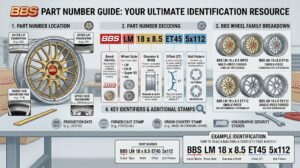
A BBS part number is not just a product code. It is a document of authenticity. A traceable record that connects every genuine BBS component to a specific production run, a specific face designation, a specific barrel specification, and a specific place in the BBS manufacturing history. For enthusiasts, collectors, and builders who work with genuine BBS wheels — understanding how to read a BBS part number is the single most powerful tool available for verifying authenticity, identifying correct components, and making informed purchasing decisions in a market saturated with replicas and misrepresented products.
At Elite BBS Wheels, we reference BBS part numbers on every build we produce. When we build a set of BBS E88 wheels for a Porsche 991 GT3-RS using faces 0289046 and 0289047, those numbers are not arbitrary reference codes. They are verifiable identifiers that connect those specific faces to BBS’s production records — confirming material specification, manufacturing origin, and component authenticity in a way that no amount of visual inspection alone can achieve.
This guide explains the BBS part number system completely — how it is structured, what each element means, how to use it to verify authenticity, and how knowing the correct part numbers for your specific application protects you from the replica market’s most convincing deceptions. Whether you are buying your first genuine BBS set or your fiftieth, understanding BBS part numbers is knowledge that pays for itself every time you use it.
Why BBS Part Numbers Are So Frequently Misused and Misunderstood
The BBS part number system exists as a verification tool — but it only functions as one if buyers understand how to use it.
The replica wheel market has recognized this. Modern BBS replicas frequently carry engraved or laser-etched sequences that resemble genuine BBS part numbers — sequences designed to satisfy a casual inspection without triggering the deeper verification that would expose them as counterfeit. Some replica sellers go further, incorporating genuine BBS part numbers sourced from legitimate product listings into their own marketing — creating a situation where a buyer searching for a specific BBS part number finds both the genuine component and a replica claiming to be the same thing, with no obvious way to distinguish between them at the point of purchase.
This misuse of the BBS part number system creates several specific problems for buyers.
First, it undermines price confidence. When a replica carrying a genuine BBS part number is priced at a fraction of the cost of the genuine component, buyers who do not understand the verification process may conclude that the genuine product is overpriced rather than that the replica is fraudulent.
Second, it creates fitment confusion. BBS part numbers encode specific dimensional and construction information. A replica carrying a genuine BBS part number but built to different dimensions — different hub bore, different bolt circle diameter, different face geometry — will not fit correctly on the platform the genuine component was designed for, regardless of what the part number implies.
Third, it erodes trust in the BBS market generally. When buyers cannot reliably verify what they are buying, they become reluctant to invest at the level that genuine BBS quality justifies — which ultimately damages the entire authentic BBS ecosystem and benefits only the replica manufacturers who profit from that uncertainty.
Understanding how BBS part numbers actually work — how they are structured, what they encode, and how to verify them — eliminates all three of these problems at once.
How to Read a BBS Part Number Completely
The Structure of a BBS Part Number
BBS part numbers follow a consistent structural format that encodes information about the component type, the face or barrel designation, the bolt pattern, and the specific production variant.
A standard BBS part number consists of a sequence of digits — typically seven to ten characters — that can be broken down into distinct segments. Each segment encodes a specific category of information about the component. Understanding what each segment represents allows you to extract the component’s identity, its intended application, and its position in the BBS catalogue from the number itself.
The general structure of a BBS part number looks like this:
0 2 8 9 0 4 6
Breaking this down:
- The first one or two digits identify the component category — face, barrel, hardware, or complete wheel assembly
- The middle digits identify the specific face or barrel design designation within the BBS catalogue
- The final digits identify the specific variant within that design — bolt pattern, hub bore, width, or finish specification
This structure means that two BBS E88 faces for different platforms will share some digits — reflecting their shared face design — while differing in the final digits that encode their platform-specific dimensional specifications. Knowing how to read these shared and differing elements allows you to identify not just what a component is, but exactly which variant it is and whether it is the correct variant for your specific application.
BBS Face Part Numbers — How to Identify the Face Design
BBS face part numbers begin with the digit sequence that identifies the face as a face component — distinguishing it from barrel, hardware, and complete wheel part numbers in the BBS system.
Within the face category, the middle digits identify the specific face design. The BBS E88 face design, for example, carries a consistent middle digit sequence across all its variants — a sequence that appears in every E88 part number regardless of bolt pattern, hub bore, or finish specification. Recognizing this sequence tells you immediately that you are looking at an E88 face — not a different design that might share some external visual characteristics with the E88 but belongs to a different design family.
The final digits of the face part number identify the specific variant — the bolt pattern, the hub bore, the finish specification, and in some cases the diameter. This is where the 5×112 / 57.1mm variant of the BBS E88 face is distinguished from the 5×120 variant used on BMW platforms, the Center Lock variant used on Porsche platforms, and the 5×114.3 variant used on certain Japanese market applications.
For example — in the context of BBS E88 Porsche fitments, faces 0289046 and 0289047 are the correct front and rear designations for specific Porsche CL applications. The shared 028904 sequence identifies both as E88 faces within the same Porsche fitment family. The final digit — 6 for fronts and 7 for rears — distinguishes the front face variant from the rear face variant within that fitment. This level of specificity is what makes BBS part numbers genuinely useful as verification tools — and what makes replica part numbers, which typically reproduce only the middle digits without the correct final variant codes, identifiable as fraudulent under proper scrutiny.
BBS Barrel Part Numbers — LM, E88, and RS Series
BBS barrel part numbers follow the same structural logic as face part numbers — identifying the barrel design family, the specific variant, and the dimensional specification — but encode different information specific to barrel geometry.
The BBS LM barrel program — one of the most respected barrel production operations in the BBS catalogue — uses a specific part number series that identifies the barrel diameter, the barrel width, and the specific LM series designation. LM357 and LM358, for example, are specific barrel designations used in BBS RT-88 builds — the 357 for front applications and the 358 for rear applications in specific staggered fitment configurations. Knowing these numbers allows a builder to verify that the barrels in a completed build are genuine LM program components rather than generic barrels sourced from alternative suppliers.
BBS RS barrel part numbers follow a similar logic — identifying the RS series, the barrel width, and the specific variant within the RS barrel family. RS727 and RS728, for example, are specific RS2 face designations used in three-piece conversion builds — numbers that identify the face design, the RS2 series, and the specific front and rear variants within that series. These numbers are traceable in BBS production records and verifiable against BBS catalogue documentation in a way that replica part numbers are not.
RT-88 Face Part Numbers — RT026, RT027, and the NOS Designation
The BBS RT-88 face part number series uses the RT prefix to identify components within the RT-88 road wheel programme — the programme that produced the road-legal evolution of the BBS E88 race wheel.
RT026 and RT027 are specific RT-88 face designations — RT027 for front applications and RT026 for rear applications in specific BMW fitment configurations. These are not currently available through BBS’s standard distribution channels — they are NOS (New Old Stock) designations that were purchased before the specification was discontinued, making them genuinely scarce and genuinely valuable components in the current market.
The NOS designation in BBS part number context refers specifically to components that were produced during active BBS production runs, purchased and stored before availability ended, and are now available only through suppliers who acquired stock during the active production period. NOS components carry the same genuine BBS part numbers as standard production components — because they are standard production components, simply sourced from pre-discontinuation stock rather than current production. This distinguishes them from replica components that carry fake part numbers, and from refurbished or refinished components that may carry genuine numbers but represent modified originals rather than unmodified production stock.
How to Verify a BBS Part Number
Verifying a BBS part number is a straightforward process for anyone with access to BBS catalogue documentation or a supplier relationship with direct BBS access.
The primary verification method is cross-referencing the part number against BBS’s production catalogue — a detailed record of every component BBS has produced, organized by part number, design designation, dimensional specification, and production period. A genuine BBS part number will appear in this catalogue with full specification details. A replica part number — whether invented or copied inaccurately from a genuine component — will either not appear in the catalogue at all, or will appear with specifications that do not match the component being verified.
At Elite BBS Wheels, we verify every component we use in our builds against BBS catalogue documentation before the build is started. Every part number we reference in our product listings is a genuine BBS part number traceable to BBS production records. When we specify face 0289046 for a Porsche CL build, that number exists in the BBS catalogue, its specifications match the component we are using, and its authenticity can be confirmed by any buyer with access to the same catalogue documentation.
The secondary verification method — and one accessible to buyers without catalogue access — is weight and dimensional measurement. Genuine BBS components are produced to precise dimensional tolerances that replica components consistently fail to meet. A face that claims to be a specific BBS part number but measures differently from the documented dimensions of that part number — in outer diameter, hub bore, bolt circle diameter, spoke thickness, or center depth — is not the component the part number claims it to be.
Common Fake Part Number Patterns to Watch For
Understanding how genuine BBS part numbers are structured makes it significantly easier to identify fake part numbers on replica products.
The most common fake part number pattern on BBS replicas is a sequence that reproduces the middle digits of a genuine BBS part number — the design family identifiers that appear across multiple genuine variants — while using incorrect or invented final digits that do not correspond to any real variant in the BBS catalogue. This produces a number that looks structurally similar to a genuine BBS part number at a glance but does not match any real component when cross-referenced against catalogue documentation.
A second common pattern is the use of complete genuine BBS part numbers — sourced from legitimate product listings and marketing materials — on replica components that share the visual profile of the genuine component but differ in every structural characteristic. This is the most deceptive form of part number misuse because the number itself is real — it simply does not belong to the component it is engraved on.
A third pattern specific to the multi-piece wheel market is the use of genuine BBS face part numbers on assemblies that combine genuine BBS faces with non-BBS barrels and hardware. In this case the face part number may be genuine — but the completed wheel is not a genuine BBS build because the barrel and hardware do not meet BBS specifications. At Elite BBS Wheels, every build we produce uses genuine BBS components throughout — face, barrel, and hardware — and we specify part numbers for all structural components, not just the face.
BBS Part Numbers in Real Elite BBS Wheels Builds
Part Numbers from Real Builds That Tell the Complete Story
BBS E88 for Porsche 991 GT3-RS — Faces 0289046 / 0289047
These are the correct BBS E88 face part numbers for specific Porsche Center Lock applications — 0289046 for the front wheels and 0289047 for the rear wheels. Both numbers are traceable in BBS production records. The shared 028904 sequence identifies both as E88 faces within the same Porsche CL fitment family. The final digit distinguishes front from rear. When Elite BBS Wheels specifies these numbers on a Porsche GT3-RS build, every buyer can verify that the faces we are using are exactly what we claim they are.
BBS RT-88 for BMW E9X M3 — Faces RT027 / RT026
RT027 front and RT026 rear — genuine BBS RT-88 NOS face designations for specific BMW M fitment configurations. Both are discontinued and available only through suppliers with pre-discontinuation stock. Both carry part numbers traceable to BBS RT-88 programme production records. The RT prefix identifies them as RT-88 road wheel programme components. The 026 and 027 suffixes identify the specific front and rear variants within that programme. Genuine, verifiable, and impossible to replicate correctly without access to the original production components.
BBS RS2 Three-Piece Conversion — Faces RS727 / RS728
RS727 rear and RS728 front — genuine BBS RS2 face designations used in three-piece double step conversion builds for platforms including the BMW G8X M3, M4, and M2. Both numbers identify the RS2 series, the specific face variant, and the front or rear application within the RS2 catalogue. Cross-referenced against BBS catalogue documentation, both numbers confirm the faces as genuine RS2 components produced by BBS to RS2 design and material specifications.
BBS LM Barrels — LM357 / LM358
LM357 front and LM358 rear — genuine BBS LM programme barrel designations used in BBS RT-88 builds on BMW platforms. Both numbers identify the LM programme, the specific barrel diameter and width, and the front or rear variant within the LM barrel range. New LM357 and LM358 barrels combined with genuine RT-88 faces produce a completed wheel that carries genuine BBS part numbers throughout — face and barrel — and can be verified as a complete genuine BBS build from every component outward.
Generally a BBS part number is the most reliable verification tool available in the genuine BBS wheel market — and understanding how to read one is the single most effective protection against the replica industry’s most convincing deceptions.
Genuine BBS part numbers are structured, traceable, and verifiable. They encode real information about real components produced by BBS to BBS specifications. They exist in BBS production records and can be confirmed by anyone with access to catalogue documentation. And they connect every genuine BBS component — face, barrel, hardware — to a specific production history that replica manufacturers cannot replicate, cannot fake convincingly under proper scrutiny, and cannot benefit from in the collector and enthusiast market where provenance is recognized and rewarded.
At Elite BBS Wheels, part numbers are not decorative details. They are the foundation of every build we produce — the verifiable evidence that the components we use are exactly what we claim them to be. When you build with Elite BBS Wheels, you build with components whose part numbers tell the complete story of what they are, where they came from, and why they are worth owning.
Want to Verify Your BBS Components or Plan a Genuine BBS Build?
At Elite BBS Wheels, we work with genuine BBS part numbers on every build we produce — and we are happy to help you verify the authenticity of BBS components you already own or are considering purchasing.
If you are planning a genuine BBS build and want to make sure every component carries a verifiable part number traceable to BBS production records, we are ready to build it for you.
Visit elitebbswheels.com or contact us privately today — tell us your platform, your vision, and your specification, and we will build a genuine BBS set where every part number tells the right story.
Posts Widget
-
1
 Genuine BBS Forged Wheels Delivered to Enthusiasts Around the World
Copyright 2014 © elitebbswheels.com